
Running a Sex Offender Check in Oneida County
Begin with the Idaho Central Sex Offender Registry, the official source administered by Idaho State Police's Bureau of Criminal Identification. Accept its use warning before searching. The registry receives information from county sheriffs, the Idaho Department of Correction, and juvenile justice. It also warns that records may change and that ordinary identifiers are not positive identification.
Use several paths for Oneida County. Run County=Oneida, City=Malad, and a name search if a known person is involved. An address-radius search adds a neighborhood view. The pending and non-compliant lists can reveal records that a narrow place search misses. If the concern crosses Idaho's border, add the national search rather than assuming the state portal covers another jurisdiction.
Oneida County Registration Counter
Local registration and verification occur through the Oneida County Sheriff's courthouse service. The office is on the lower level at 10 Court Street, Malad City, ID 83252. Call (208) 766-2251 to confirm appointment times, counter hours, and fee handling. This is also the right first contact when an Oneida County registry profile displays information that appears wrong.
The sheriff gathers the registration form, photograph, fingerprints, and full palm prints, then forwards the material to ISP. A person establishing residence generally must register with the county sheriff within two working days, and the sheriff sends the materials onward within three working days. Public users should report suspected noncompliance to the sheriff or ISP. They should not confront the registrant.
Oneida County Sheriff
Sex-offender registration service
10 Court Street, lower level
Malad City, ID 83252
(208) 766-2251
Searching the Idaho Central Sex Offender Registry
The state interface supports Name, City, County, Zip, and Map searches. A careful Oneida County registry check moves from broad place filters to a more exact view:
- Accept the official registry warning and search County for Oneida.
- Run a separate City search for Malad so city labels do not hide a county match.
- Use Name or Zip when those facts are known, then compare aliases and physical details.
- Search an address at 1, 3, and 5 miles, recognizing that pins show general proximity.
- Review violent-predator, non-compliant, and pending lists, then confirm concerns with the verification sheriff shown.
The official Idaho map-search form shows the exact radius controls available to the public.
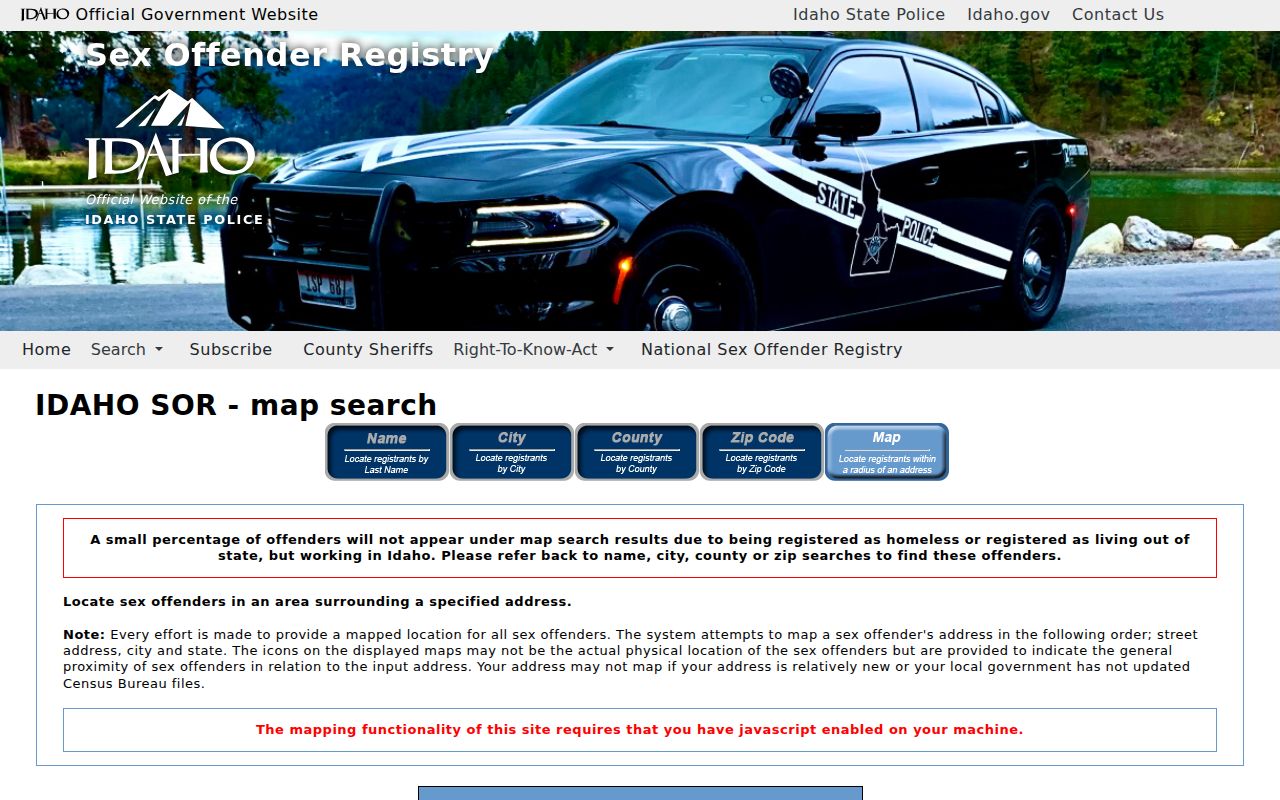
That form is useful for a defined Malad address, but its own warnings explain why it cannot stand alone.
| Search control | Input | Use |
|---|---|---|
| Name | Person's known name | Compare identity and aliases |
| City | Malad | City-labeled profiles |
| County | Oneida | Countywide results |
| Zip | Known ZIP code | Postal-area check |
| Map | Street, city, Idaho | 1, 3, or 5 mile radius |
Oneida County Map Search Gaps
A map marker is not a guaranteed doorway. The registry says its icons show general proximity, not necessarily an exact location. Homeless registrants may have no fixed address to plot. An out-of-state resident who works in Idaho may also fail to appear on an address map even though a public registry record exists.
For those reasons, pair the map with county, city, name, and status-list searches. Check nearby roads at more than one radius when the question is neighborhood awareness. A missing map icon is not proof that no registrant is associated with Oneida County. It only means the chosen map query did not return one.
Note: Map results are a proximity tool, while the profile and verification agency provide the record details that require careful comparison.
What a Registry Profile Shows
An official profile combines public identity, location, status, and offense fields. Compare the whole profile, not just a photograph or shared name. Age, aliases, physical description, conviction jurisdiction, and the verification agency help distinguish records involving similar names.
| Identity | Full name, aliases, photograph, date of birth or age |
|---|---|
| Description | Sex, race, height, weight, hair, eyes, scars, marks, and tattoos |
| Location | Public address, city, county, and ZIP when legally available |
| Status | Registry designation, compliance or pending status |
| Offense | Description, statute, conviction jurisdiction, and related public facts |
| Verification | Registration or verification agency to contact about a possible error |
Social Security numbers, driver's-license numbers, telephone numbers, online identifiers, and law-enforcement-only information are not public. The portal's identity warning matters. A similar name and birth date do not establish that the person being considered is the registrant.
Oneida County Status Lists
Idaho maintains dedicated views for violent sexual predators, non-compliant offenders, and pending-status offenders. These categories answer different questions. A pending designation signals that the registry process or status is not settled. Non-compliant identifies a duty problem reflected by the system. Violent sexual predator is a statutory designation with enhanced verification.
The official violent sexual predator interface demonstrates that the state treats designation lists as a separate search layer.
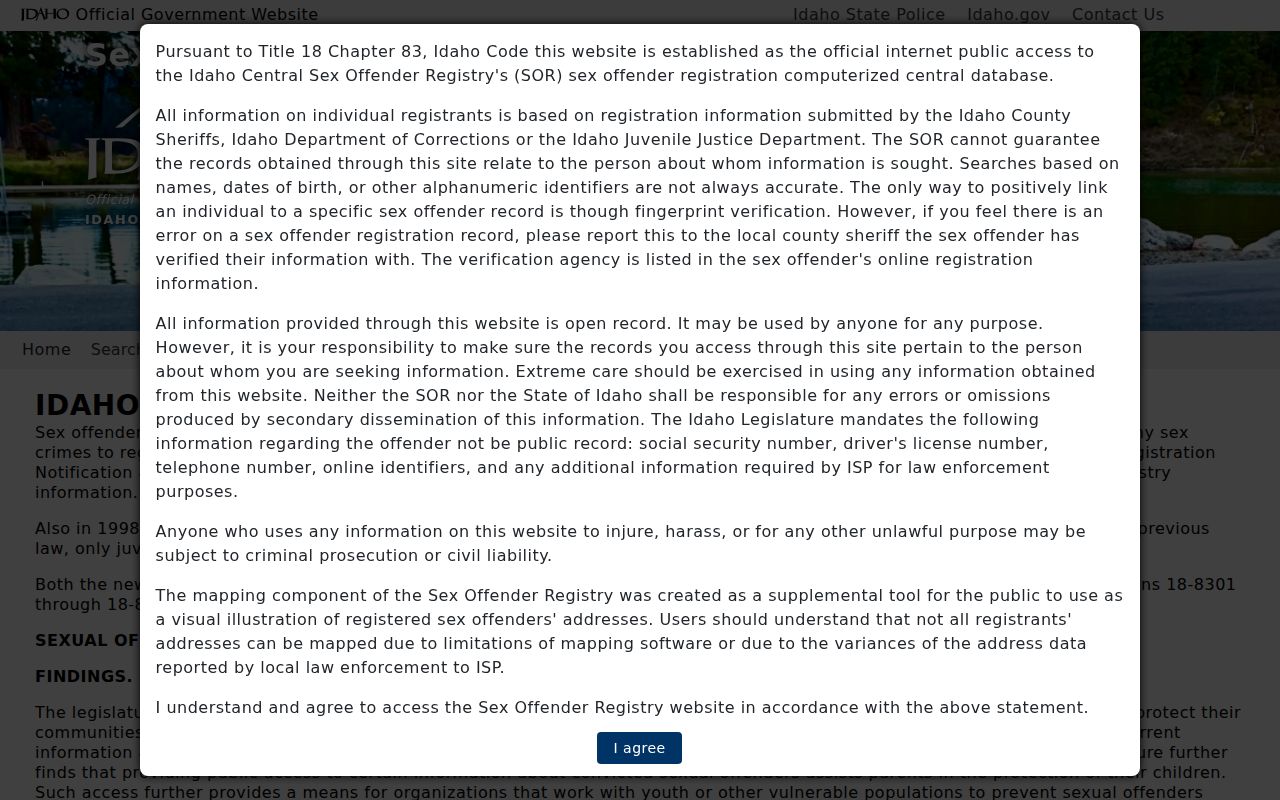
Reviewing these lists alongside Oneida County results closes gaps that can arise when a record's address or compliance status is changing.
Read a status label as a current registry field, not as a new conviction or a full account of the underlying case. The public profile identifies the offense and conviction details that Idaho law permits the registry to display. Court filings remain a separate record layer. When a status appears unclear, the verification agency listed on the profile is the proper place to ask what the label means.
Registration Requirements and Levels in Idaho
Idaho does not present a simple public Tier I, Tier II, and Tier III scheme. The key public distinction is registered sexual offender versus violent sexual predator, with pending and non-compliant status layered onto the record. Idaho Code §18-8307 sets lifetime registration as the baseline, while §18-8310 provides a petition path for some eligible registrants after its conditions and period are met.
| Idaho designation | Verification | Baseline | Visibility |
|---|---|---|---|
| Registered sexual offender | Annual after mailed notice | Life, subject to statutory relief | Public central-registry information |
| Violent sexual predator | Every three months | Life | Public profile and list |
| Non-compliant or pending | Status-specific | Duty continues until resolved | Dedicated public lists |
The current statute states an $80 annual fee for other offenders. A violent predator pays $50 at the first quarterly registration and $10 for each later quarter that calendar year, subject to an indigency waiver. Fees and duties concern registration, not public search access.
Positive Oneida County Identity Matches
Fingerprint verification is the only positive link between a person and an Idaho registry record. Photographs can age. Names, birth dates, and physical traits can overlap. A user who sees a possible match should compare the full public profile and contact the listed verification sheriff about an apparent factual error.
Do not treat the map as proof of a precise home, and do not infer facts the profile does not state. The official warning protects both public safety and accuracy. The broader Oneida County criminal history overview explains why court, sheriff, and BCI records also answer different questions.
An identity concern should be handled through the official agency rather than social media or neighborhood speculation. Record the profile's verification office, status, and public identifying fields, then state the suspected error with care. That approach gives the sheriff or ISP enough detail to locate the registry entry without spreading an unverified claim.
Oneida County and NSOPW
The Dru Sjodin National Sex Offender Public Website is the national cross-state layer. It searches participating jurisdictions and is useful in a border county when a safety question extends beyond Idaho. Use it after the Idaho searches, not as a substitute for Oneida County's local verification channel.
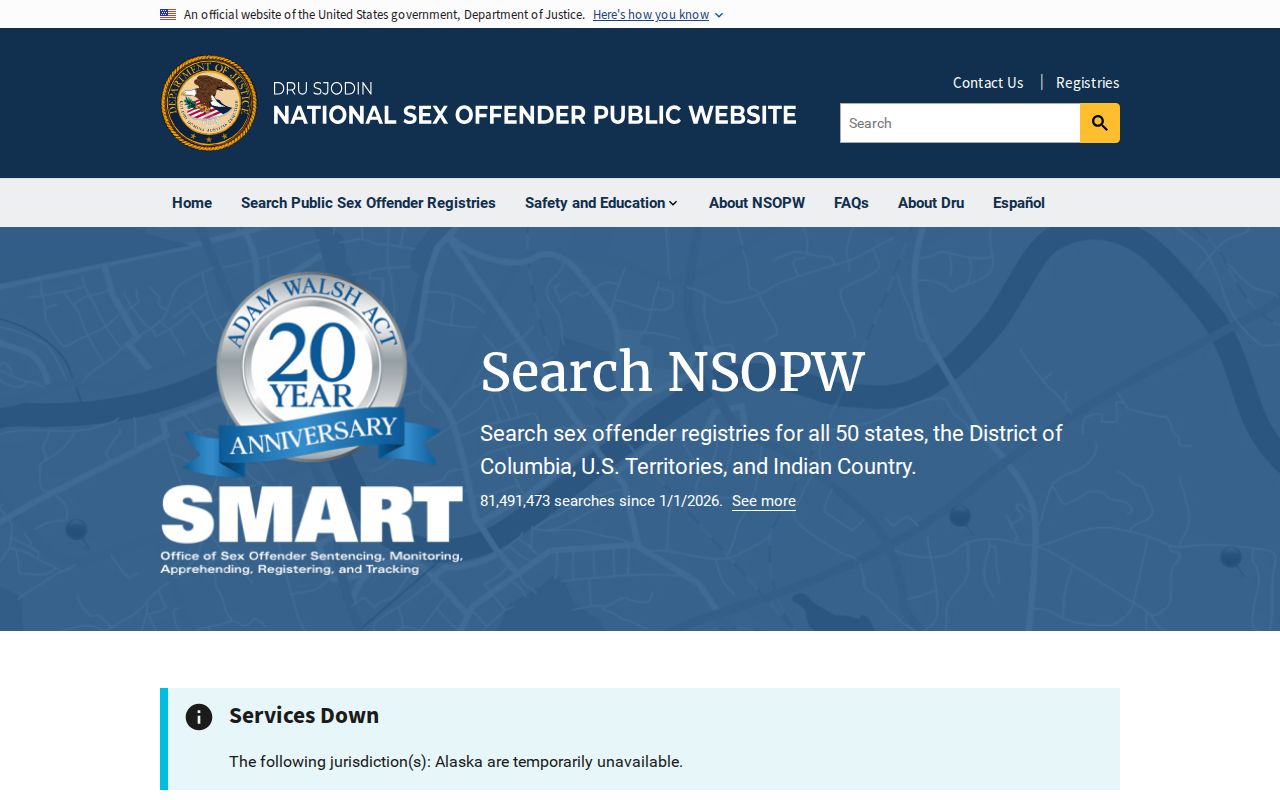
The national interface broadens geographic reach, while Idaho's profile and Oneida County Sheriff remain the best sources for state-specific status and local verification.
A useful cross-state check repeats the known name in NSOPW, reviews the participating-jurisdiction result, and then opens the source jurisdiction's official profile for detail. Return to Idaho's registry for an Oneida County location question. National aggregation can reveal another state's entry, while the Idaho portal explains Idaho status terms and points to the local verification office.
Lawful Use and Community Notification
Registry information exists for public protection and community awareness. Idaho law permits defined central-registry information to be public, but it does not authorize threats, intimidation, injury, or other unlawful action. Oneida County does not publish a verified sheriff app or separate community-alert product. Use the official registry, NSOPW, and direct sheriff contact instead.
Misuse is a crime. Idaho Code §18-8326 prohibits specified injurious or unlawful use of registry information. Criminal prosecution and civil liability may follow. Report a concern to law enforcement rather than confronting anyone.
When an address seems stale or a person appears non-compliant, preserve the profile details needed to identify the record and call Oneida County Sheriff at (208) 766-2251. ISP can address central-system concerns. Public users should not attempt their own surveillance or enforcement.
Keep the report clear and factual. State which official search was used, what public field appears inconsistent, and why the location or status may need prompt review. The sheriff can compare that notice with its registration materials and send updates through the state process when appropriate. Emergency threats still belong on emergency channels; ordinary registry corrections do not.